


Your first visit is a consultation. We review what has and hasn’t worked, your medications and your imaging, then plan the steps toward a correct diagnosis. We do not prescribe controlled substances, such as opioids, at the first visit.
Your first visit is a consultation. We review what has and hasn’t worked, your medications and your imaging, then plan the steps toward a correct diagnosis. We do not prescribe controlled substances, such as opioids, at the first visit.
You have probably been told your knee is bone on bone, and that a replacement is coming sooner or later. You may have already had surgery on it that did not help. A scan showing wear does not prove the wear is what hurts. We establish where the pain is actually coming from before anything is treated, and before anyone talks to you about replacing the joint.
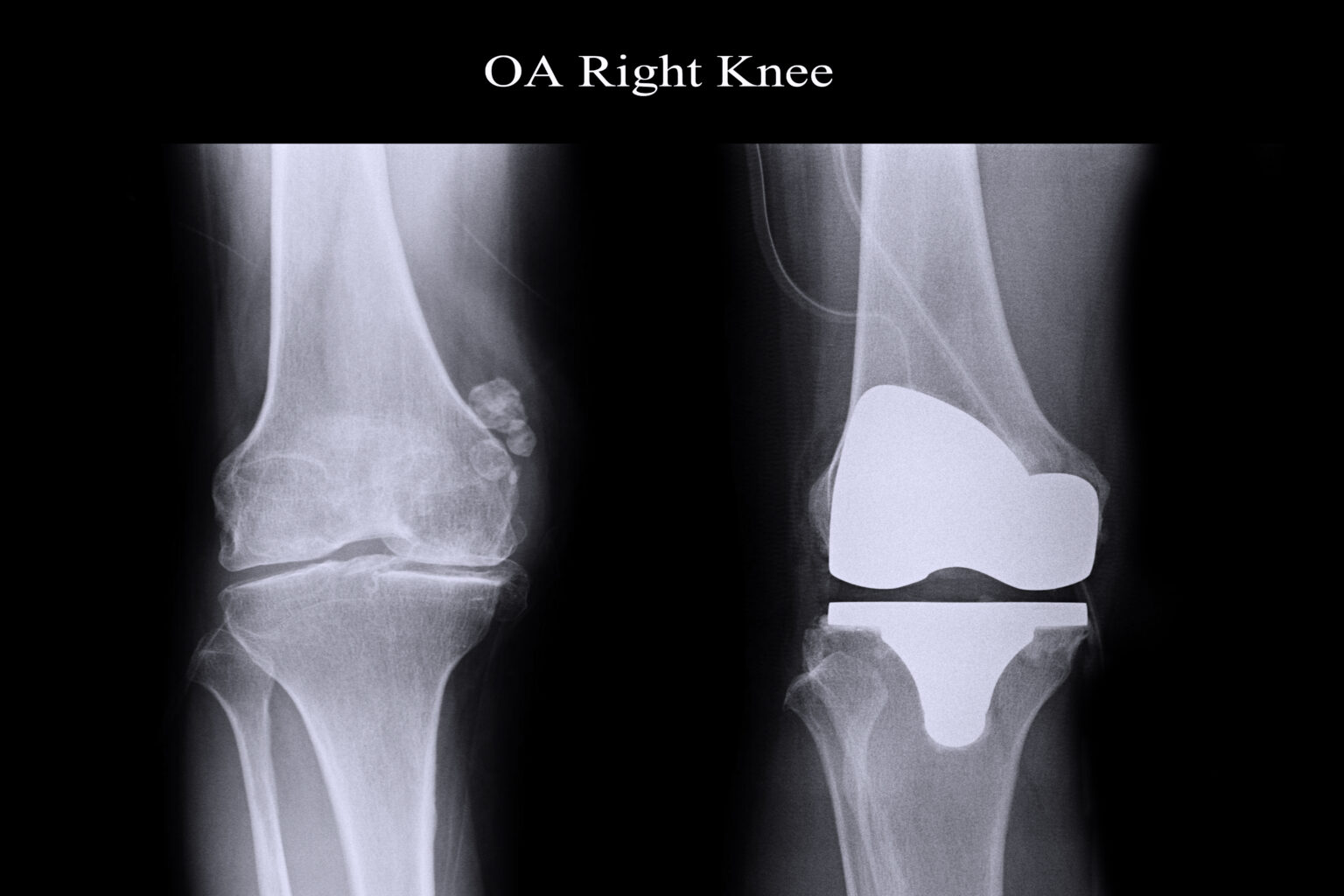
Wear shows up on imaging in most people past a certain age, whether or not it hurts. So a scan showing arthritis in your knee does not, on its own, tell anyone that the arthritis is what you are feeling. Plenty of people have a knee that looks worse than yours on film and no pain at all.
We use selective nerve blocks to find out. A numbing injection placed at one specific place, to establish whether that is the source. If the pain goes, we have found it. If it does not, we have learned something equally useful.
Finding the correct nerve is what we specialize in. The right cause, then the right treatment, for the right problem — and in that order. Every other order is a guess wearing a procedure’s name.
Knee, hip or spine? Hip Pain → · Back Pain →
X-rays of a worn knee, and the same knee after replacement.
Arthritis on an X-ray is only one possible answer. These are the other things most often behind knee pain. Tap one to see what it feels like and how it is told apart.
Coming from somewhere else
An ache at the front of the thigh or in the knee, while the knee itself looks normal, often with groin stiffness or trouble putting on socks.
Examining the hip. Pain when the hip is turned inward, and the hip X-ray, point to the hip rather than the knee.
Pain, numbness or weakness down the front of the thigh toward the knee, sometimes with back pain or the knee giving way.
A nerve examination and the knee-jerk reflex; the MRI shows the cause, and a selective nerve root block confirms the nerve.
Crystals in the joint
A sudden, very painful, hot, swollen knee — most often in people over 65.
Drawing a little fluid from the knee and finding calcium crystals in it. The X-ray may show calcium in the cartilage.
We refer you out for physical therapy and, where needed, a surgical consultation.
A red, hot, swollen knee with no injury, so tender that small movements hurt.
Testing fluid from the knee for uric acid crystals.
We refer you out for physical therapy and, where needed, a surgical consultation.
In or around the knee
Soreness on the inner side, just below the joint, worse on stairs or bending and straightening, without swelling inside the joint.
A tender spot below the inner joint line on examination. It is often mistaken for a sprain.
We refer you out for physical therapy and, where needed, a surgical consultation.
Catching, locking or sharp pain with twisting or squatting, sometimes with mild swelling.
Tenderness along the joint line, and an MRI. Tears are common on MRI in people over 50 who have no pain, so the finding has to match the symptoms.
Platelet-rich plasma (PRP) for a partial tear, where your coverage allows it; a surgical consultation when the tear needs one.
Fullness or a lump behind the knee with tightness.
Ultrasound shows the fluid-filled cyst; an MRI shows what is feeding it, such as a meniscus tear.
We refer you out for physical therapy and, where needed, a surgical consultation.
Warning signs — do not wait
A suddenly hot, swollen, extremely tender knee, sometimes with fever.
Fluid drawn from the knee.
If this is a medical emergency, call 911 or go to the nearest emergency room. Do not wait for an appointment.
Calf pain and swelling that keep getting worse. It can look like a cyst behind the knee.
An ultrasound of the leg veins, urgently.
If this is a medical emergency, call 911 or go to the nearest emergency room. Do not wait for an appointment.
Not sure which one fits? That is what the first visit is for. We test before we treat.
What the research shows
of people whose X-ray shows knee arthritis have knee pain, depending on the study.
Bedson and Croft, BMC Musculoskeletal Disorders, 2008of patients with hip arthritis had pain below the knee — and most doctors in training believed hip pain does not travel that far.
Khan et al., Annals of the Royal College of Surgeons of England, 2004Because it is honest, and because you will find out eventually anyway.
The treatments below are not all covered by every plan, and which ones are open to you depends on who insures you. That is not a judgement about which is best for your joint — it is a constraint we work inside, and we would rather you heard it from us at the start than discovered it at the billing desk.
We will tell you what your plan covers before you commit to anything.
What applies to you depends on what we found, and on what your plan will pay for. Both of those are discussed with you before anything is booked.
An option for patients on Medicare, and for patients being treated under a letter of protection after an injury. →
If you have already had surgery on it. A great many of the joints we see have already been operated on, and the operation did not fix the pain. When that happens the reason is usually one of two, and they are the same two that apply to pain after spine surgery:
The diagnosis was wrong. The operation may have been performed perfectly well on a finding that was never what was hurting you. In that case it was never going to work, and no amount of time or therapy afterwards was going to change that.
Or the pain is now coming from the surgery itself. A different situation, with its own answers.
Either way, the first job is not another procedure. It is finding out which of the two it is — which is the same thing we would have done before the first operation.
The rest of what we do. Physical therapy — some joints need it more than they need anything we can inject, and we will say so. Surgical consultation — some need a surgeon, and when that is the answer we make the referral rather than treating around it. Managing your medications — part of looking after you, alongside the rest, not the plan on its own.
Your first visit is a consultation. We go through what has and has not worked, your medications and your imaging, and plan the steps toward a correct diagnosis.