


Your first visit is a consultation. We review what has and hasn’t worked, your medications and your imaging, then plan the steps toward a correct diagnosis. We do not prescribe controlled substances, such as opioids, at the first visit.
Your first visit is a consultation. We review what has and hasn’t worked, your medications and your imaging, then plan the steps toward a correct diagnosis. We do not prescribe controlled substances, such as opioids, at the first visit.
Most shoulders we see have already been given an answer. Some have had the operation that answer led to, and it still hurts. In both cases the reason is usually the same: the diagnosis was wrong, so everything built on top of it was aimed at the wrong thing. We establish where the pain is actually coming from before anything else is done.
Wear and tearing show up on imaging in most shoulders past a certain age, whether or not they hurt. So a scan showing damage does not, on its own, tell anyone that the damage is what you are feeling. Plenty of people have a shoulder that looks worse than yours on film and no pain at all.
We use selective nerve blocks to find out. A numbing injection placed at one specific place, to establish whether that is the source. If the pain goes, we have found it. If it does not, we have learned something equally useful.
Finding the correct nerve is what we specialize in. The right cause, then the right treatment, for the right problem — and in that order. Every other order is a guess wearing a procedure’s name.
Shoulder or neck? 1 the shoulder · 2 the neck. Neck Pain →
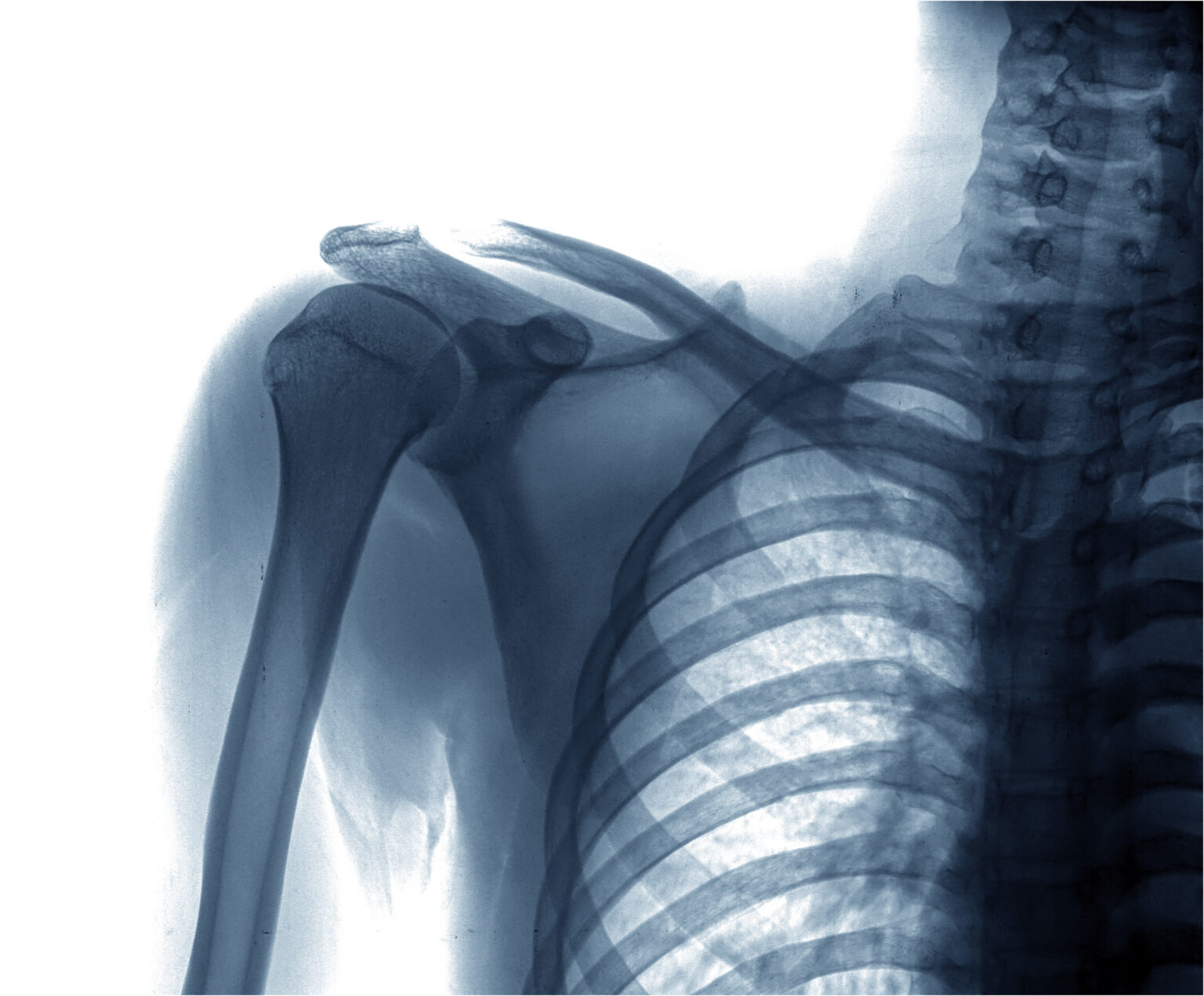
X-ray of the shoulder, with the neck alongside.
A shoulder scan shows wear or a tear in most people past a certain age. These are the other things most often behind shoulder pain. Tap one to see what it feels like and how it is told apart.
Coming from somewhere else
Pain toward the back of the shoulder that may run past the elbow, with neck pain and tingling or numbness in the arm or hand.
A neck and nerve examination. If numbing the shoulder does not change the pain, it points away from the shoulder. An MRI of the neck, and a selective nerve root block.
In the shoulder itself
An ache on the outside of the upper arm, not past the elbow, worse at night and when lifting the arm, often with weakness.
Strength tests on examination, and an MRI or ultrasound. Many cuff tears on a scan cause no pain at all, so the finding has to match the symptoms.
Platelet-rich plasma (PRP) for a partial tear, where your coverage allows it; a surgical consultation when the tear needs one.
A stiff, painful shoulder that will not move far, even when someone else moves it for you. More common with diabetes or thyroid disease.
Examination showing the shoulder will not move either way. X-rays are usually normal.
We refer you out for physical therapy and, where needed, a surgical consultation.
Pain on top of the shoulder, worse reaching across the chest.
A tender spot right over the joint, pain reaching across the body, and arthritis on X-ray.
We refer you out for physical therapy and, where needed, a surgical consultation.
Warning signs — do not wait
Shoulder pain that does not change when you move the neck, shoulder or arm, or that comes with chest pain, shortness of breath or stomach symptoms. The heart most often refers to the left shoulder.
This is not something to test in our clinic.
If this is a medical emergency, call 911 or go to the nearest emergency room. Do not wait for an appointment.
Shoulder or shoulder-blade pain running toward the hand, with weakness or tingling in the hand, sometimes a drooping eyelid.
CT or MRI of the chest. A routine chest X-ray can miss it early.
We refer you out.
Not sure which one fits? That is what the first visit is for. We test before we treat.
What the research shows
of full-thickness rotator cuff tears found in a whole community caused no symptoms.
Minagawa et al., Journal of Orthopaedics, 2013of people over 60 with no shoulder pain had a cuff tear on MRI.
cited in Burbank et al., American Family Physician, 2008Because it is honest, and because you will find out eventually anyway.
The treatments below are not all covered by every plan, and which ones are open to you depends on who insures you. That is not a judgement about which is best for your joint — it is a constraint we work inside, and we would rather you heard it from us at the start than discovered it at the billing desk.
We will tell you what your plan covers before you commit to anything.
What applies to you depends on what we found, and on what your plan will pay for. Both of those are discussed with you before anything is booked.
An option for patients on Medicare, and for patients being treated under a letter of protection after an injury. →
If you have already had surgery on it. A great many of the joints we see have already been operated on, and the operation did not fix the pain. When that happens the reason is usually one of two, and they are the same two that apply to pain after spine surgery:
The diagnosis was wrong. The operation may have been performed perfectly well on a finding that was never what was hurting you. In that case it was never going to work, and no amount of time or therapy afterwards was going to change that.
Or the pain is now coming from the surgery itself. A different situation, with its own answers.
Either way, the first job is not another procedure. It is finding out which of the two it is — which is the same thing we would have done before the first operation.
The rest of what we do. Physical therapy — some joints need it more than they need anything we can inject, and we will say so. Surgical consultation — some need a surgeon, and when that is the answer we make the referral rather than treating around it. Managing your medications — part of looking after you, alongside the rest, not the plan on its own.
Your first visit is a consultation. We go through what has and has not worked, your medications and your imaging, and plan the steps toward a correct diagnosis.